Black and Grey Realism Tattoos: What They Are and How to Choose an Artist in Miami
Jesús Jaime · 2026-10-26 · 5 min read
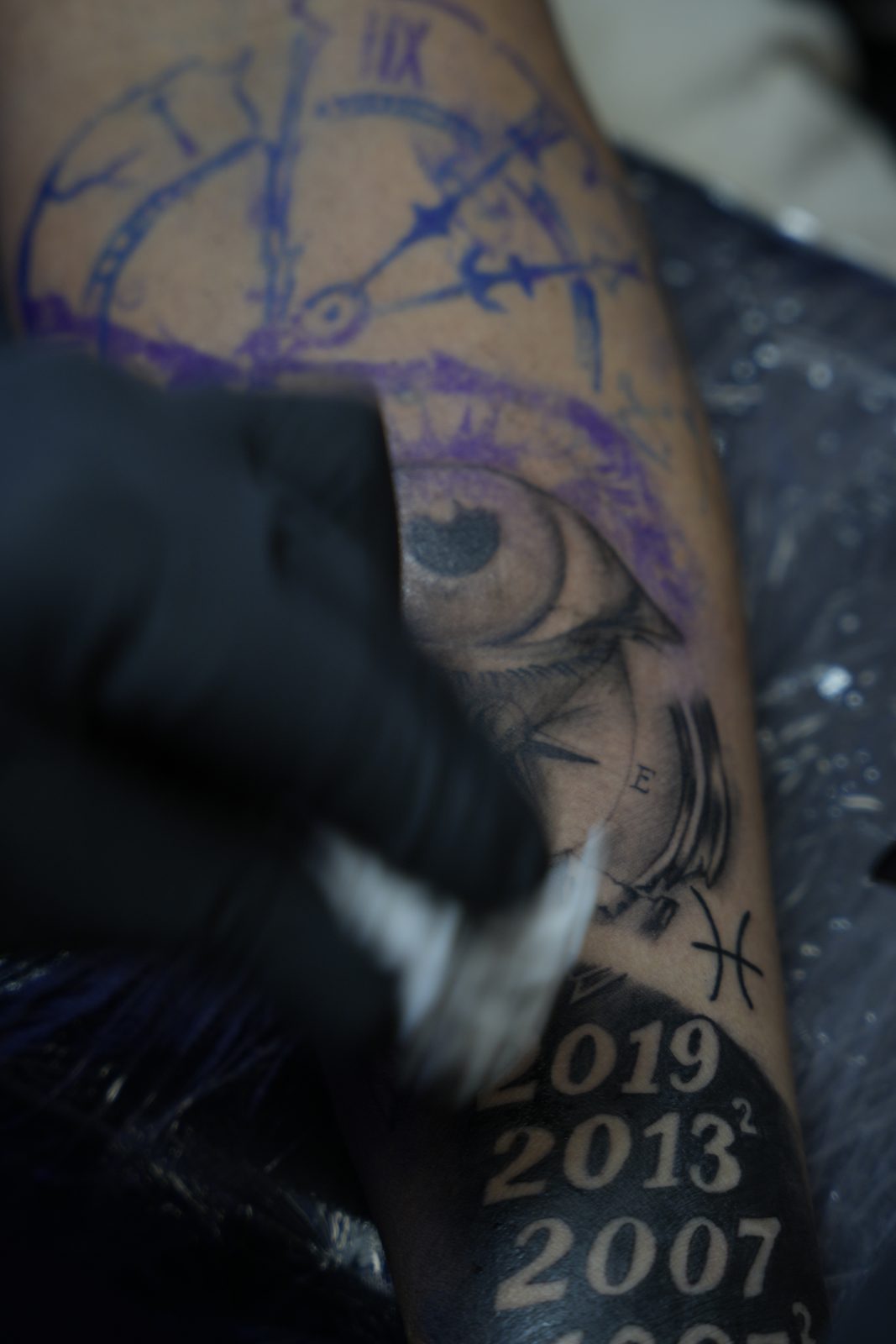
A black and grey realism tattoo is a design built only from black ink, grey washes, and the natural tone of your skin, shaded so smoothly that the image reads like a photograph: portraits, animals, statues, and religious imagery are classic subjects. There are no bold outlines holding it together, so the entire piece depends on soft gradients, correct values, and an artist who understands how those gradients will heal and settle over time.
Realism is the style people usually mean when they show a photo and say they want their tattoo to look exactly like that. Getting there is less about the machine and more about seeing: the artist translates a three-dimensional subject into flat skin using light and shadow alone. When it is rushed, or copied from a design made for someone else's body, it can turn muddy surprisingly fast.
What black and grey realism actually is
Instead of linework and flat fills, realism is built from layers of diluted black ink, often called grey wash, applied in different strengths to create a full range of tones from deep black to the lightest grey. The lightest parts of the image are frequently not ink at all, but your own skin left untouched, which is why planning the design around your skin tone matters so much in this style.
Because there is usually little or no outline, the edges of a realism piece are made by contrast: a soft cheek becomes visible because the shadow next to it is darker. That is also why realism demands patience in the chair. The artist builds tones gradually, checking constantly, rather than filling areas in one pass the way simpler styles allow.
How a realism piece comes together
- Reference and design: the image is studied, simplified where needed, and adapted to your body and skin tone.
- Stencil and mapping: key shapes and values are placed so the design flows with the muscle underneath.
- Dark values first: the deepest shadows are established to anchor the contrast of the whole piece.
- Mid-tones and blending: gradients are built in layers, working from dark toward light.
- Highlights last: the brightest points and fine textures are added at the end, often using the skin itself as the lightest value.
A good realism artist also designs with healing in mind, not just with how the piece photographs on day one. Fresh tattoos always look darker and sharper than healed ones, so experienced artists leave enough separation between tones for the image to stay clear after it softens. If those tones are all crammed together, the piece will likely blur into grey mush within a few years.
How long does a realism tattoo take?
Longer than most styles of the same size, because smooth gradients cannot be rushed. A palm-sized realism piece might take a full session of several hours, while a large portrait, a full sleeve, or a back piece is normally planned as multiple sessions spaced weeks apart, so each layer heals before the next one builds on it. Your artist should be able to give you a session estimate once the design, size, and placement are clear.
Healing, contrast, and how realism ages
Healed black and grey always looks softer and lighter than it did fresh, and that is normal. Well-built realism accounts for this by keeping strong darks where they belong, so the image keeps its contrast as it settles. Poorly built realism loses its lightest separations first, and faces, hands, and fine details are usually where weak work shows.
After healing, your habits decide the rest. Sun exposure is the biggest enemy of soft gradients, because ultraviolet light breaks down ink and flattens contrast over the years, so regular sunscreen on the healed piece is close to non-negotiable in Miami.
How to choose a realism artist in Miami
- Look at healed work, not only fresh photos: realism proves itself after it settles.
- Check the gradients: transitions should be smooth, with no scratchy or patchy bands.
- Look for clean portraits and hands, the hardest subjects to fake.
- Make sure realism is their specialty, not one style among twenty.
- Ask how they approach custom designs and whether they copy other tattoos.
Miami has plenty of talented tattooers, but realism is a specialization, and an artist who is excellent at bold traditional work may not shade the way realism requires. Study portfolios slowly, zoom in, and trust healed results over filters. A consultation should feel like planning, not pressure: the artist should talk honestly about size, detail, and what will still look good in ten years.
Why custom from scratch matters
A realism design copied from a photo of someone else's tattoo was made for their body, their skin tone, and their proportions, not yours, and it will already have lost detail in translation. A design drawn from scratch for you starts from the original reference and is composed to flow with your anatomy. It also means your piece is genuinely yours, which matters in a style this personal.
That is exactly how Jesús Jaime works at Shack Tattoo in North Miami Beach: custom black and grey designs drawn from scratch, never copies. If you have a portrait, a religious piece, or an idea you want translated into realism, send it on WhatsApp and ask for a free quote, and you will get an honest read on size, sessions, and what the design needs to age well.
Frequently asked questions
Does black and grey realism fade faster than other styles?
It does not fade faster, but it shows fading differently: because the style depends on soft contrast instead of bold outlines, sun damage and poor healing flatten it sooner. Well-built pieces with strong dark values age gracefully, and sunscreen on the healed tattoo is the single best habit for keeping the gradients smooth.
Can any photo be turned into a black and grey realism tattoo?
Almost any subject can be adapted, but not every photo works as-is. Blurry, low-contrast, or very small references usually need to be enlarged, simplified, or combined with better source images so the important details survive at tattoo size. A good artist will tell you honestly what your reference needs before the session is booked.
How big does a realism portrait need to be?
Bigger than most people expect. Fine facial detail needs room: cramming a portrait into a tiny space guarantees the features will soften together as the tattoo ages. Your artist can recommend a minimum size for your specific reference and placement, and trusting that recommendation is one of the easiest ways to protect the result.
Ready for yours?
Free consultation and quote with Jesús Jaime on WhatsApp. Designs from scratch, never copied.
Free Quote